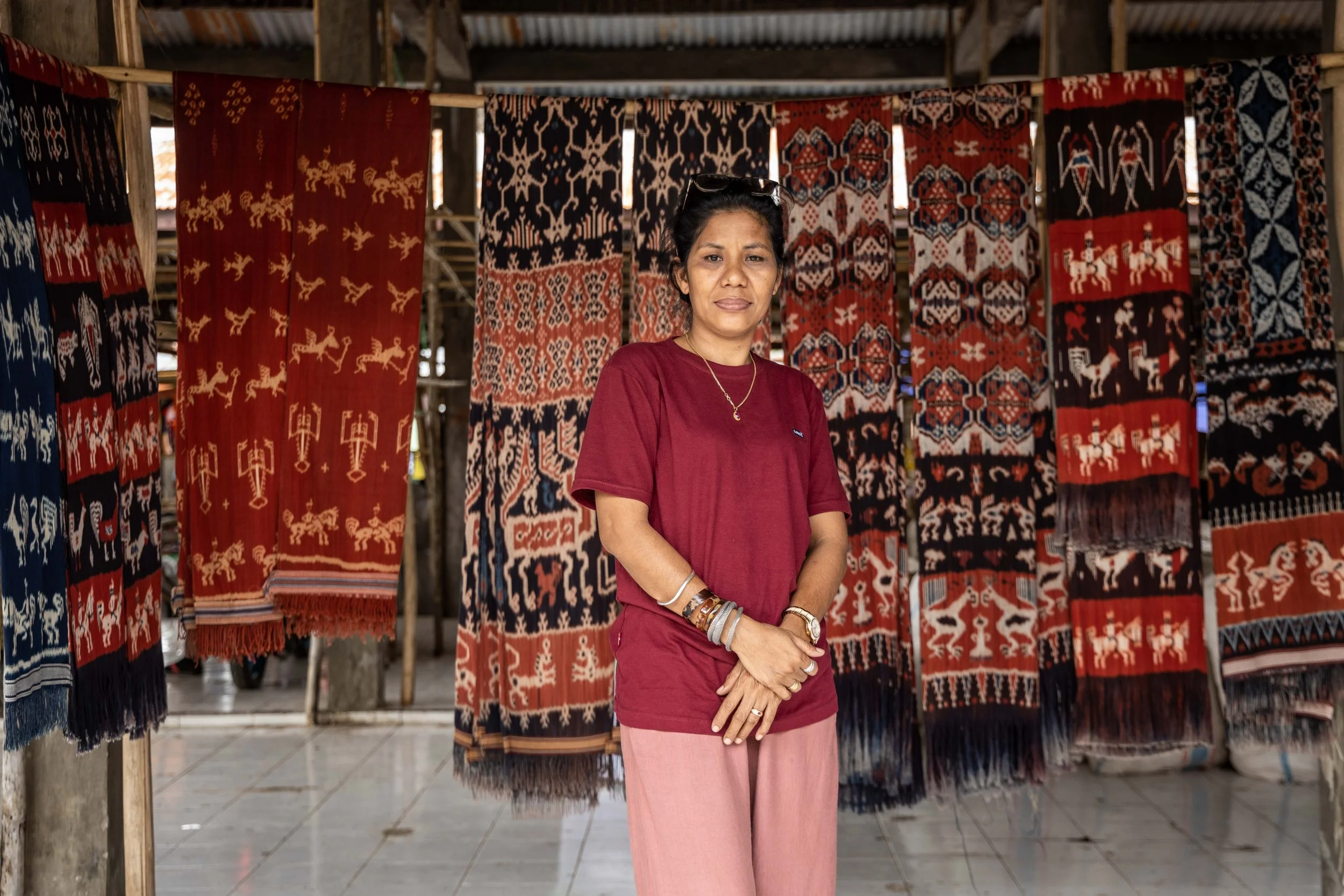
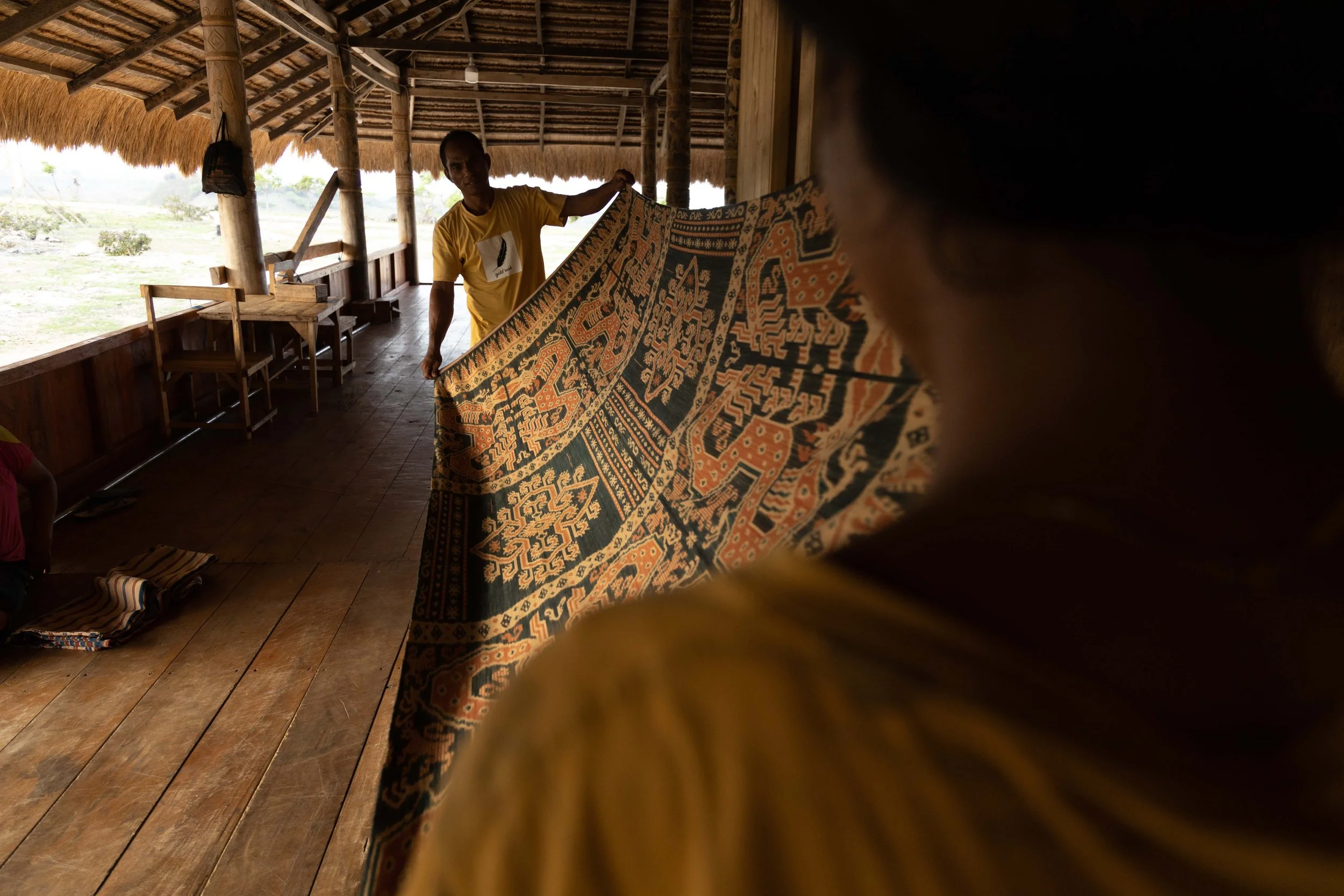
On photo: Asti, a helper from the Melolo weaving house.
In the shade of a thatched communal weaving house outside Melolo, Hana's hands move with practiced grace. Her wooden heddle stick glides through brilliantly dyed cotton warp threads—indigo blue, morinda red, turmeric yellow—conjuring patterns that have adorned Sumbanese cloth for centuries. Beside her, her daughter watches intently, learning not just a craft but a language: crocodiles for protection, horses for wealth, ancestral spirits watching over the living.
This is tenun ikat, the resist-dye weaving technique that has defined Sumba's cultural identity for generations. But on this small Indonesian island, barely 200 kilometers long and perched at the eastern edge of the archipelago, the ancient art is becoming something else entirely—a lifeline in a warming world.
An Island on the Edge
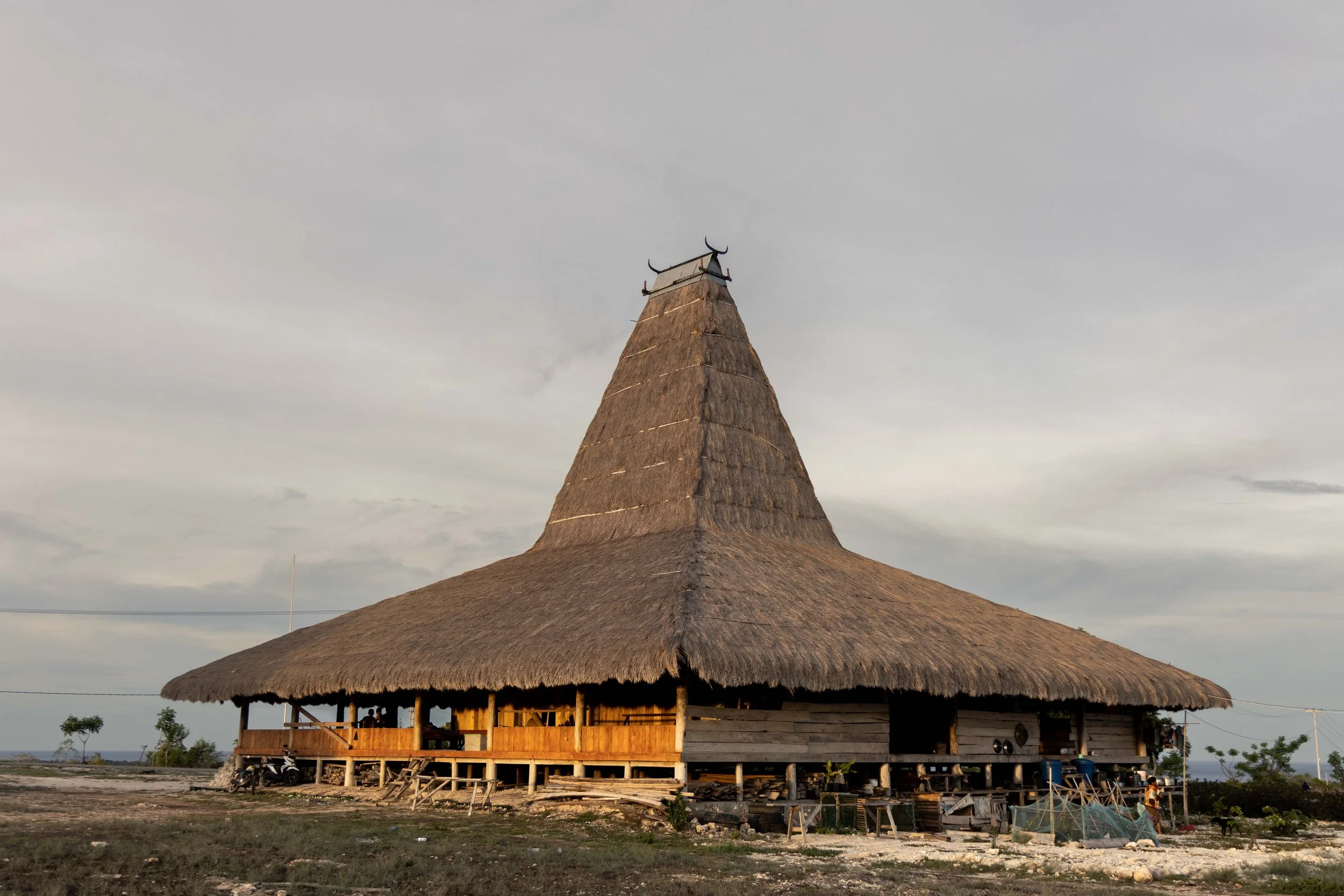
Sumba can often be defined by its endless limestone hills and arid soil where little vegetation can grow. Located in one of Indonesia's most severely climate-sensitive regions and considered an ecological forefront for desertification, this fragile ecosystem beats to the rhythm of three things: the abundance of water for crops, animals, and people; the upholding of their millennia-old textile-making tradition; and the carrying of their ancient Marapu belief.
East Sumba has always been arid, its landscape shaped by hot north-Australian winds and limestone savannahs. But over recent decades, the wet season has contracted from six months to just three, leaving farmers scrambling to grow enough rice, corn, and cassava to feed their families. The dry season now routinely brings extreme droughts exceeding 60 days without rain, turning the already sparse landscape into a sun-scorched expanse where little can survive.
The eastern part of Sumba has lived on the constant brink of drought manifestation, but for the past decade, this precarious balance has dwindled, resulting in a decrease in agricultural and livestock activities and the displacement of populations off the island. As warming climates dry the land and water finds itself scarcer than ever, those barren limestone hills immortalize Sumba's enduring beauty—and its deepening crisis.
When the Rhythms Break
For generations, life here followed a predictable pattern. During the rainy season, Sumbanese people would work in the fields; in the dryer season, they would stay at home weaving their tenun ikat to later sell at markets or keep as heirlooms. But with a warming climate came shorter rainy seasons, affecting the growth of cereals and sustenance for animals. Climate change and COVID-19 severely impacted the island's livelihood, causing irreparable loss of harvests and unprecedented economic strain. As harvests dwindled, the local population needed to compensate somehow.
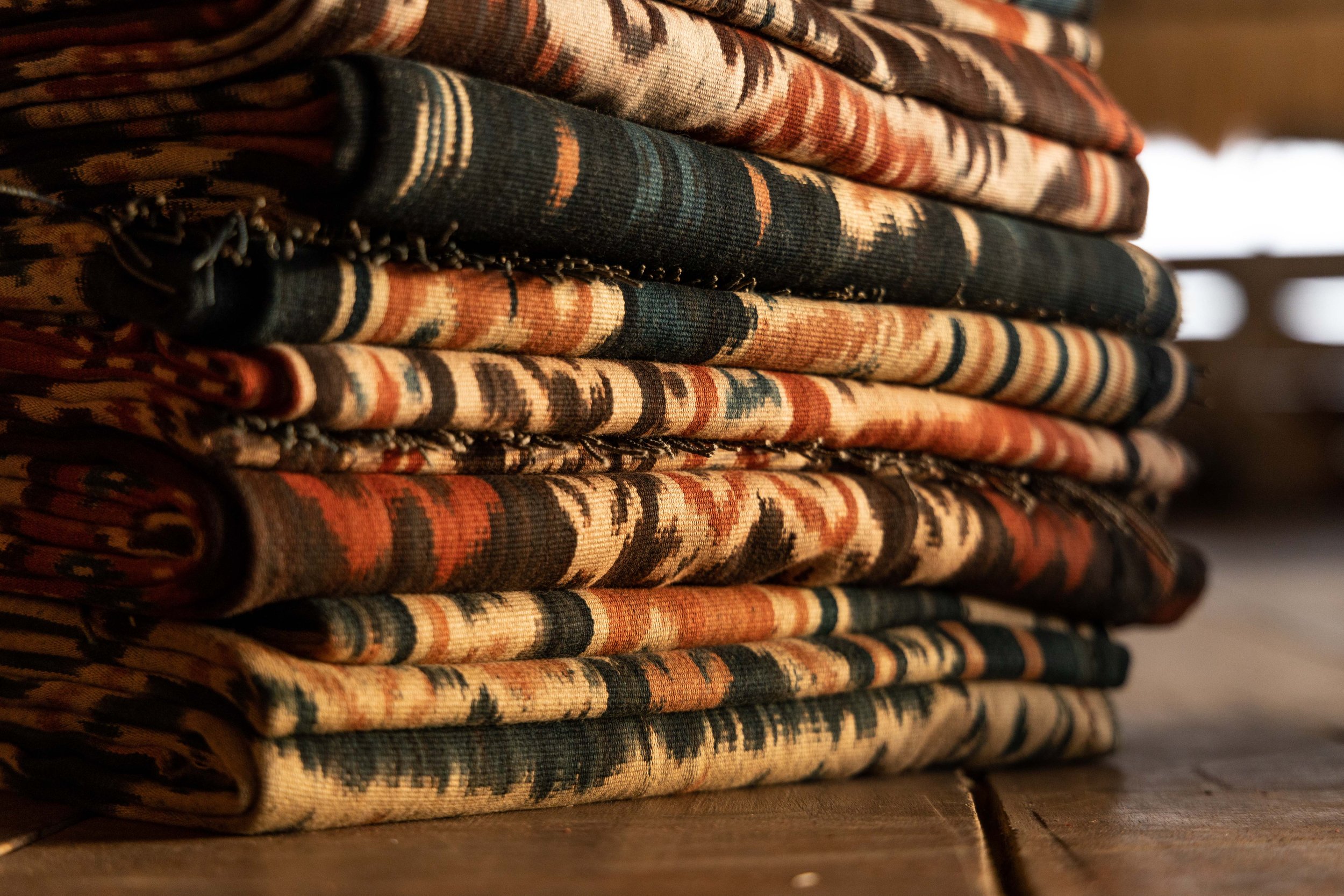
Despite the average monthly salary hovering around 150 US dollars, the textiles themselves tell a different economic story. Each fabric sold at local markets costs at least 300 dollars due to the lengthy creation process. In the UK, such fabric could easily reach 1,500 pounds at resale. But many pieces never leave the island—they're used for everything: as a gift from a mother to her child, as a cover against the cold of night, as currency for a dowry, as a book narrating stories of successes and losses, as adornment, or even as a symbol of a life well lived in funeral ceremonies.
The Fabric of Identity
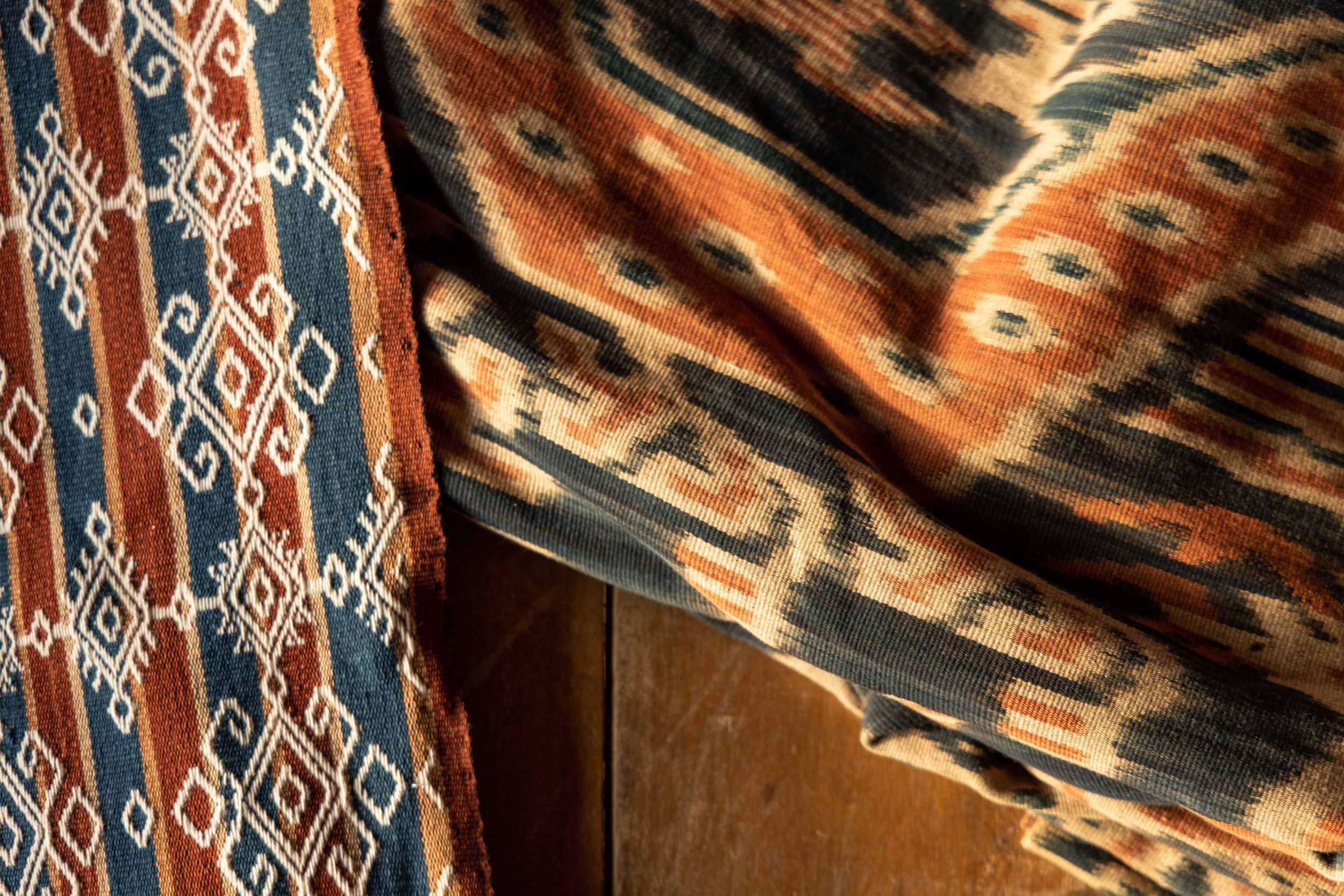
Tenun ikat Sumba, or Sumbanese woven fabric, is a textile made from cotton naturally growing on the island. It reflects the enduring cultural heritage shaped by centuries of tradition. Each piece is meticulously crafted, representing a profound connection to Sumba's rich heritage and its Marapu belief. From the cotton to the herbs and woods used for dye, every fabric is purely made out of the island's natural elements, reflecting the health and challenging environmental conditions of the island, necessitating resourcefulness and sustainability from its people.
The symbols on Sumbanese fabric narrate stories. Each of the roughly 70 traditional motifs has a very specific meaning and are often used to talk about the story of either the island or the person and family that made the fabric. There are skull trees recalling pre-colonial headhunting, omega-shaped mamuli pendants representing fertility and marriage exchange, shrimp and lobsters symbolizing renewal and regeneration. Motifs including animals, plants, and spirits feature prominently, symbolizing the interconnectedness of the natural and spiritual worlds—the crocodile represents strength and protection, while the horse symbolizes wealth and power.
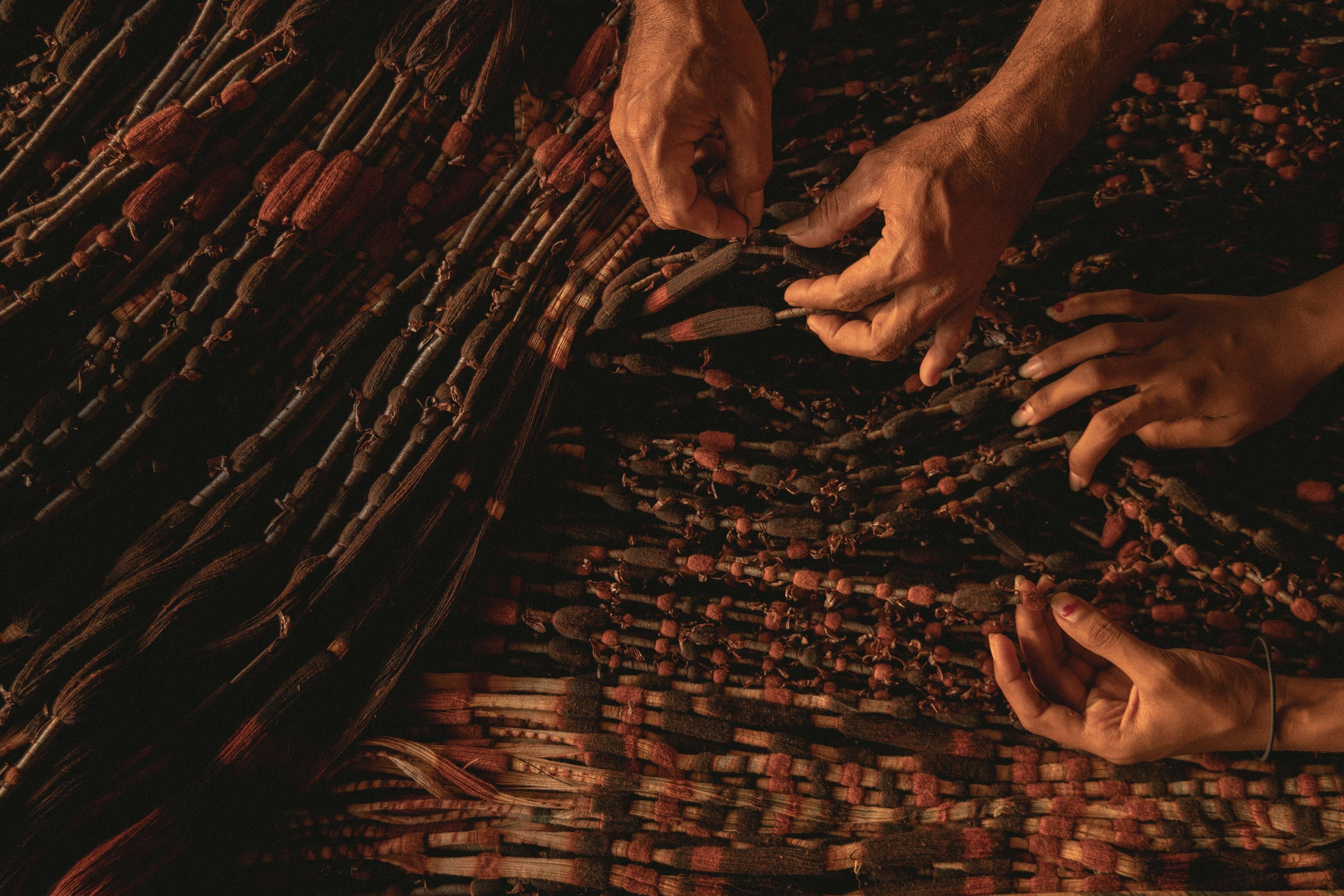
The process is painstakingly slow. A single traditional piece of tenun ikat cloth can take up to a year to complete, passing through 42 stages of work. The technique involves binding warp threads in patterns before dyeing them, creating the signature slightly blurred designs that make each textile unique. These fabrics are the quintessential symbol of Sumbanese identity and a core part of how the culture is expressed in everyday life. From the cotton to the dye to their thick and enduring fabric lasting up to a century, each woven thread interconnects every single person and aspect of Sumbanese society in the most subtle of ways.
Colors Born from Aridity
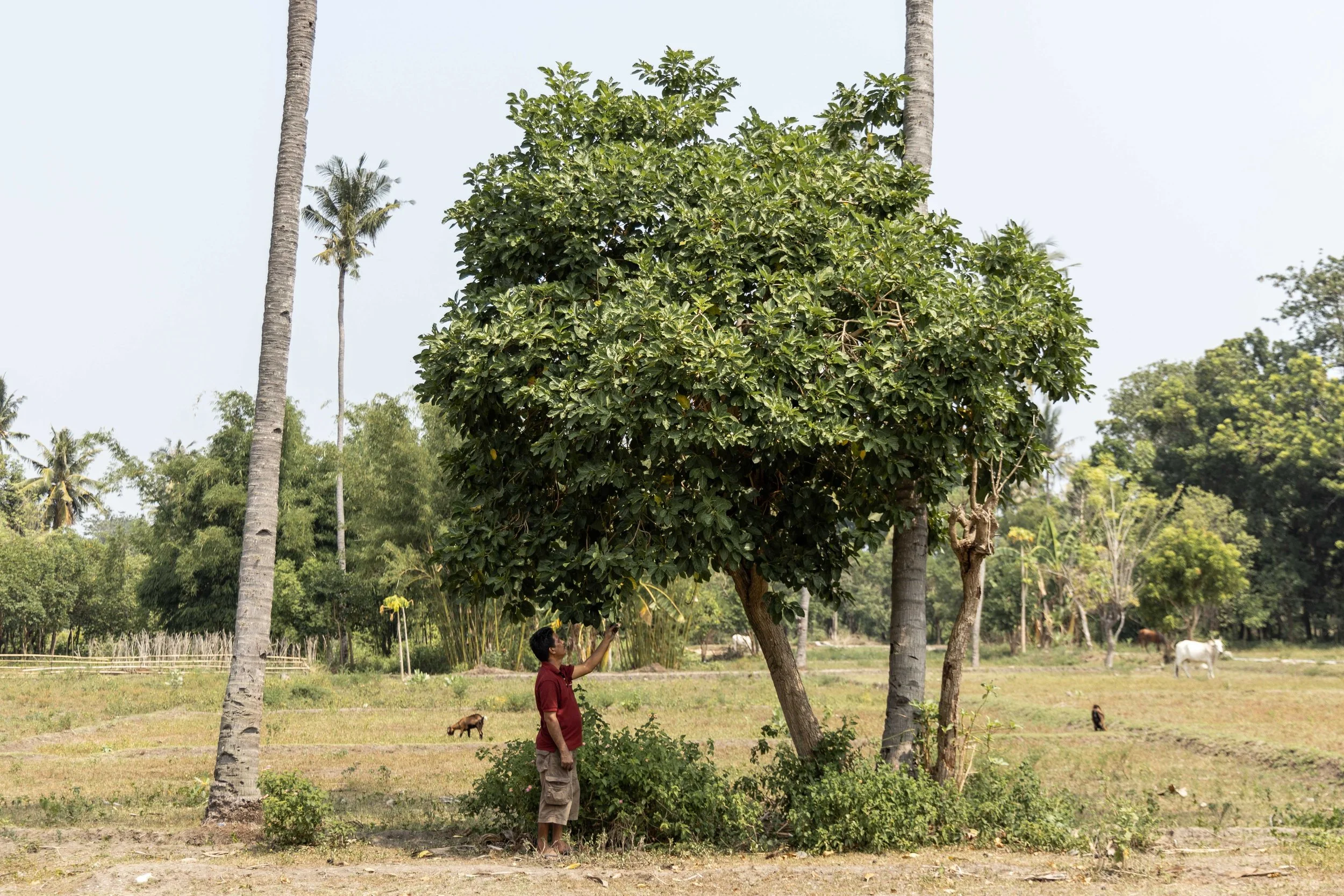
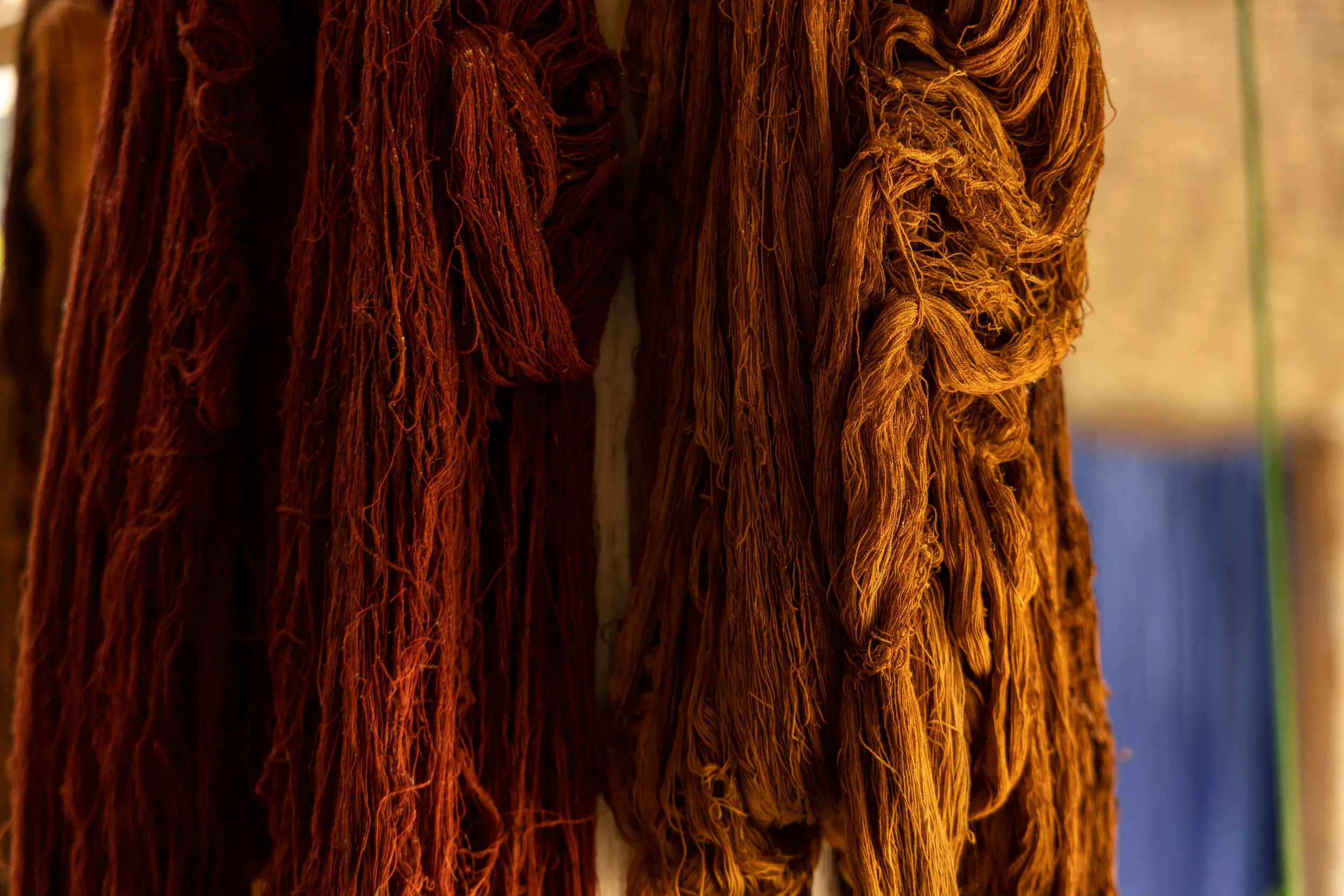
Sumba's vibrant colors are derived from natural ingredients found across the island. The intricate dyeing process, adapted to the island's arid climate, showcases the Sumbanese people's ingenuity in utilizing their environment. Indigofera tinctoria herbs provide the blue dye via fermentation. Red comes from the roots of the fruit-bearing morinda trees. Yellow flows from turmeric. All of these plants are hardy enough to grow in the difficult dry conditions that devastate conventional crops.
Unlike water-intensive commercial cotton cultivation, Sumbanese ikat takes full advantage of the eastern part's arid climate. In the face of a warming climate and dwindling harvests, it is exactly this use of the island's aridity that allows Sumbanese people to make a fabric that is essentially climate-change-proof and a reliable economic solution to loss of harvests. The textiles, recounting millennia-old narratives, deeply mirror the island's arid climate and are an extension and symbol of the island's wellbeing.
A Tradition Opens Its Doors
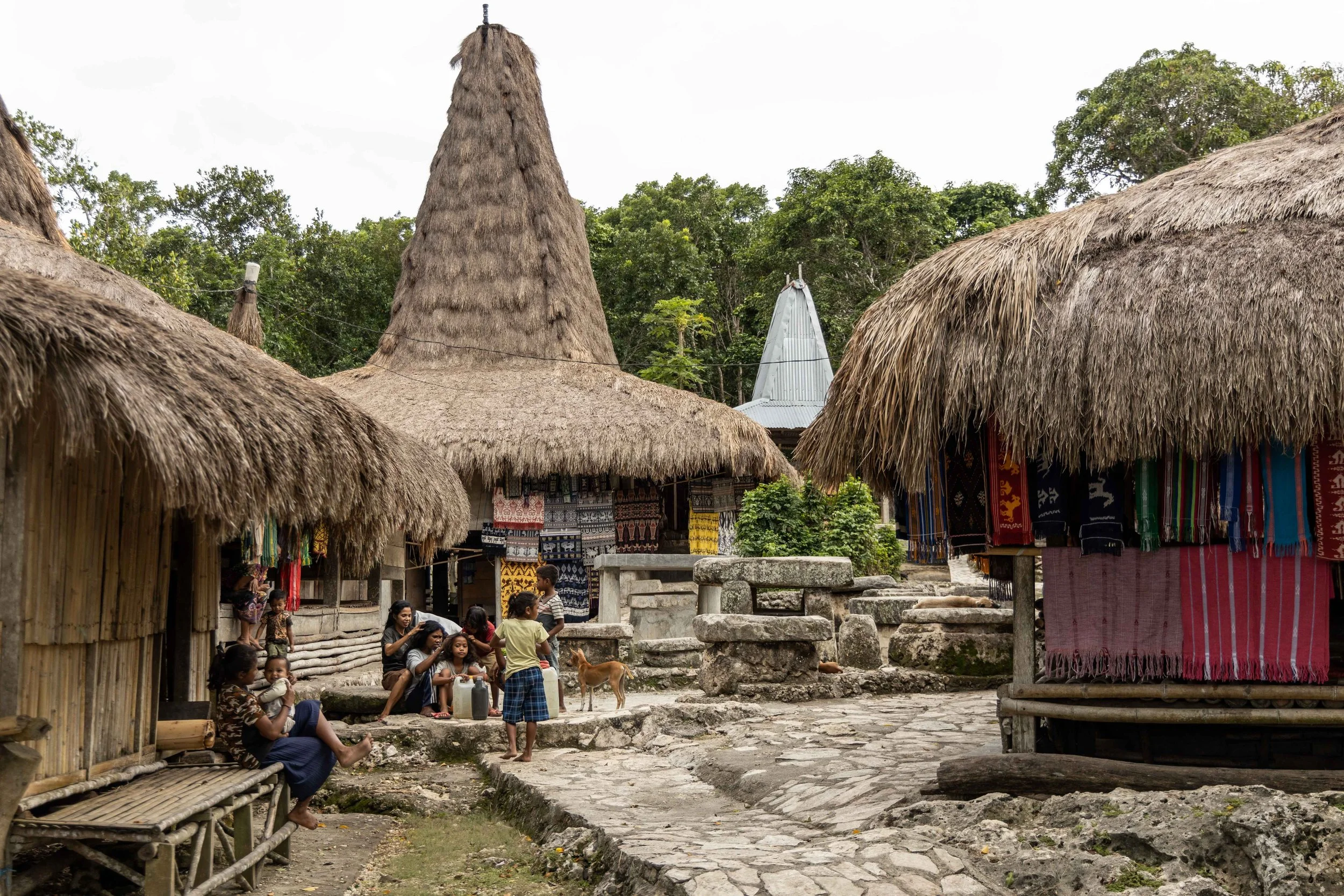
Within the communal weaving house—a place meant for making traditional textiles—dedicated women come together to share skills, stories, and traditions, fostering a sense of unity and heritage. Sumbanese women come to the weaving house as often as needed, benefiting from all the community and tools necessary to create their very time-consuming fabric. Through this collective effort, they find community and resources to carry on the legacy of their culture through the creation and export of their textiles.
But the weaving houses now welcome new faces. After school, children like Audi often help, offering support to older women while they weave—helping in the creation of dye, fetching tools and water, taking the opportunity to learn the craft themselves and later pass it on when they become older. Whenever she's not directly helping with the textile creation process, Asti, one of the helping children of the Melolo Valley, tends to the younger kids while the parents of the weaving house are busy.
Then there's Umbu Nadwa, carefully taping together individual threads for the color-binding process. As a man, he represents the evolving culture—his practice of tenun ikat breaks a long tradition where only women of an advanced age were allowed to weave and manipulate the elements of the island to make the fabric. But following the resurgence and subsequent democratization of the textile, young women and men are now allowed to weave, partaking in the tradition and putting their own stories and essence into it, intertwining ancient Marapu belief through contemporary creativity. His participation brings a fresh perspective to Sumba's weaving tradition, infusing it with innovation and inclusivity, ensuring its relevance and vitality in contemporary society.
Weaving a New Economy
In 2020, in efforts from the local government and the population to offset the increasing effects of water scarcity, they decided to focus their efforts on the production and export of their traditional textile. All these hopes of exporting this ancient textile coalesced into the east Sumbanese community of Melolo, a small cradle of peace situated in a shy but arid valley located inland close to the coast, empowering weavers in a network that allows them to export their craft abroad and make the community thrive.
Rambu Ana acts as a facilitator of cultural exchange and middlewoman, serving as a conduit for exporting Sumba's rich heritage abroad through its famed textile. Through her intermediary role, she promotes cross-cultural understanding and appreciation, showcasing the artistry and craftsmanship of Sumba's weavers on the global stage. Through resellers like her, the cloth reaches buyers in online marketplaces, antique shops, and even modern international brands.
The people of the island turned this revival into a dynamic pursuit, coming as an opportunity to export traditions and stimulate Sumba's own growth as its number one cultural export. Be it across Europe, Asia, or North America, the textile, once confined to tradition, now serves as a medium of togetherness to share Sumba's cultural narrative globally, as well as support local communities aiming to offset the impact of ever-diminishing harvests.
The Sacred and the Commercial
Always seen during cultural ceremonies such as the Pasola or the Penuburan—a funeral where people celebrate someone's passing—Sumbanese textiles find poignant expression, woven into funeral rites as a symbol of reverence and tradition. Certain patterns honor the ancestors at a funeral, while others bless a marriage. The fabrics are often buried with their owner along with their most precious belongings. This quintessential presence underscores the fabric's deep cultural significance, woven into the fabric of Sumba's social and spiritual life.
For the Sumbanese, who follow the animistic Marapu belief system, these textiles don't merely adorn—they connect the living to the dead, the earthly to the spiritual, the present to deep time. Sumbanese culture is fundamentally about the interconnectedness and inter-reliance of their people with one another. Weaving textile isn't just a cultural activity; it itself is part of the invisible fabric that permeates every node and fiber of their cultural makeup. The creation of this ancient textile is for the Sumbanese the cultural medium that connects all: nature, people, animals, places, memories and generations, past and future, sunrise and sundown—and sunrise again.
Threads Woven Forward
As Hana's heddle stick moves through the warp one more time, a horse takes shape—legs stretched in full gallop, a symbol of wealth and power that has adorned Sumbanese textiles for centuries. Her daughter watches, memorizing the pattern, learning which threads to bind and which to leave free for the dye to penetrate. Using age-old tools and techniques, Hana will pass her knowledge and skills to her daughter, ensuring the continuity of Sumba's weaving tradition for generations to come.
Outside the weaving house, the landscape tells a story of challenge: cracked earth, sparse vegetation, springs that have vanished. But inside, in the cool shade, the old knowledge persists—transformed, yes, opened to new hands, adapted to new markets, but fundamentally unchanged. The crocodile still represents strength. The ancestral spirits still watch. And the Sumbanese still weave, binding their past to an uncertain future, one thread at a time.
With the island gaining more and more momentum due to its exponentially increasing tourism industry—looking for a simpler experience than what may be found in Bali—Sumba's future remains largely positive. But the threat of water scarcity remains a serious issue at hand. Still, thanks to its climate-change-proof textile embodying the tenacity of its natural environment and people, Sumba has everything it needs to weave its own fate.
The Pattern Emerges
As Hana's heddle stick moves through the warp one more time, a horse takes shape—legs stretched in full gallop, a symbol of wealth and power that has adorned Sumbanese textiles for centuries. Her daughter watches, memorizing the pattern, learning which threads to bind and which to leave free for the dye to penetrate.
Outside the weaving house, the landscape tells a different story: cracked earth, sparse vegetation, springs that have vanished with the forests. But inside, in the cool shade, the old knowledge persists—transformed, yes, opened to new hands, adapted to new markets, but fundamentally unchanged. The crocodile still represents strength. The ancestral spirits still watch. And the Sumbanese still weave, binding their past to an uncertain future, one thread at a time.
In a world reshaped by climate change, perhaps this is what resilience looks like: not resistance to change, but the ability to incorporate it into the pattern—to take the new threads and weave them into the tapestry of life, creating something both ancient and entirely new.